By Yuni Tech Inc. Team4 minutes read
What Makes Transportation Software Different from Generic Business Software
Topic:CRM
Why generic tools break down
A lot of businesses start the same way: "We just need software to manage our operations." For a retail shop or a consulting firm, that might genuinely mean a CRM, an inventory tool, and a scheduling app bolted together. For a transportation or logistics business, that approach usually breaks within the first few months of real use.
Transportation software isn't generic business software with a map view added on top. It's a different category of problem entirely, and understanding why matters before you start scoping a build.
Real-time isn't optional
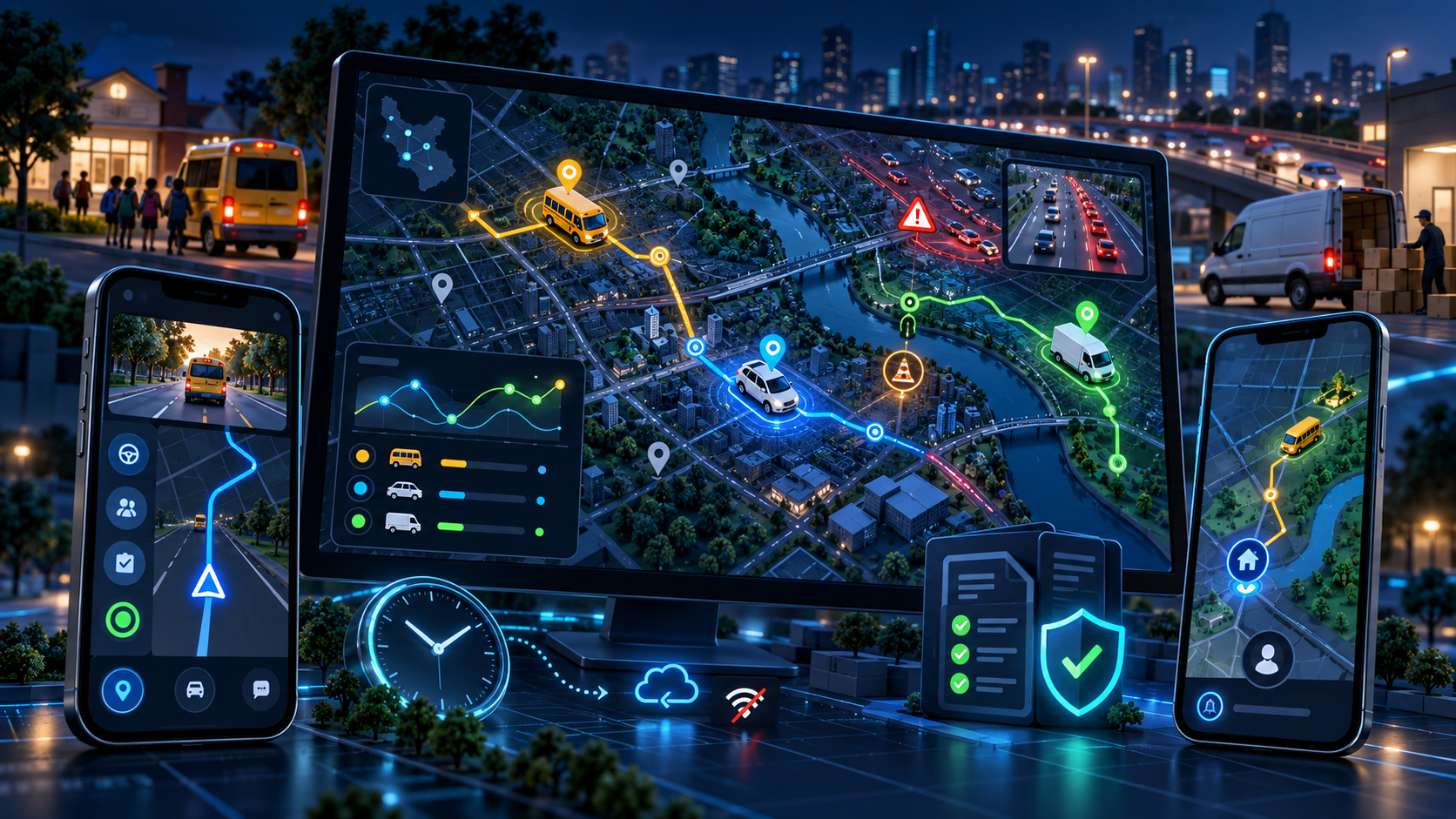
Most business software can tolerate a little lag. A CRM updating a contact record five seconds late doesn't break anything. But this can't be applied to transportation software, as a vehicle's location, route status, and a driver's availability need to be reflected in real time within seconds because decisions depend on it. Dispatch needs to know if a vehicle broke down before a customer calls asking where their delivery is. A parent needs to know if a school route is delayed before they're standing at an empty curb.
Generic business software is built around eventual consistency; data catches up soon enough. Transportation software must be built around near-real-time state, because the physical world it's tracking doesn't wait.
Geography is a first-class problem, not a feature bolt-on
A lot of software takes location as an information field on the record or maybe a pin on a map for reference. Transportation software has to treat geography as core logic: route optimization, geofencing, ETA calculation based on live traffic conditions, and handling the genuinely messy reality of real-world addresses, road closures, and service boundaries that don't line up neatly with zip codes.
This is why transportation platforms need genuine mapping and routing infrastructure, not just an embedded map widget. The routing engine must understand distance, time, and constraints together, not just draw a line between two points.
Compliance isn't a feature, it's the foundation
Generic business software might have a compliance checkbox somewhere for GDPR or basic data privacy. Transportation software, especially in regulated categories like student transportation, medical transportation (NEMT), or commercial freight, is built around compliance from the ground up. Driver hour limits, vehicle inspection records, insurance documentation, incident reporting formats: these aren't optional add-ons, they're structural requirements the software has to enforce, not just store.
A generic CRM doesn't need to know that a driver's certification expired yesterday and block them from being assigned a route. Transportation software does, because getting that wrong has real consequences beyond a bad customer experience.
Multiple stakeholders, each needing a different view of the same data
A retail inventory system usually has one primary user type: staff managing stock. Transportation software routinely needs to serve several audiences simultaneously off the same underlying data: dispatchers coordinating routes in real time, drivers needing simple, low-distraction mobile interfaces while operating a vehicle, and customers or parents wanting a simplified, reassuring view of where their ride or delivery actually is.
Designing three genuinely different interfaces on top of one real-time data layer is a harder design and architecture problem than most generic business software ever has to solve, because a single-purpose CRM usually only needs one coherent user experience, not three simultaneous ones with very different needs and stakes.
Failure has a different cost
If a generic project-management tool goes down for twenty minutes, that's an inconvenience. If a transportation platform's real-time tracking goes down for twenty minutes during active routes, dispatchers lose visibility into vehicles carrying actual people or time-sensitive medical supplies. The uptime and reliability bar for transportation software is closer to what critical infrastructure software requires than what typical SaaS tools require, because the software isn't just managing information, it's directly supporting something happening in the physical world right now.
What this means when you're building or buying
If you're a transportation, logistics, or fleet-based business evaluating software, generic business tools stretched to cover routing, real-time tracking, and compliance usually reveal their limits fast, once real volume and real-world messiness hit. The right approach is usually purpose-built software, or a generic platform's infrastructure combined with a transportation-specific layer designed around the problems above: real-time state, genuine routing logic, compliance built into the data model, and interfaces designed for each stakeholder separately.
Generic software asks, "how do we track this business generally." Transportation software has to ask, "how do we track something moving through physical space, right now, with real stakes if we get it wrong."
The bottom line
Transportation software isn't a CRM with extra fields. It's built around real-time state, genuine geographic logic, compliance as a structural requirement rather than an afterthought, multiple simultaneous stakeholder views, and a reliability bar closer to critical infrastructure than typical business tools. Understanding that distinction upfront is what separates a platform that scales with a transportation business from one that quietly becomes the bottleneck it was supposed to solve.
Building transportation software?Let's talk it through.
Planning a transportation or fleet platform? Share your workflows with Yuni Tech Inc. and we'll help you work out what it needs to do.
Related articles
- CRM
When a Custom CRM Is Worth Building
By Yuni Tech Inc. Team5 minutes read
- Mobile Apps
What Affects the Cost of Building an Uber-Like App?
By Yuni Tech Inc. Team4 minutes read
- Mobile Apps
Flutter vs React Native in 2026: How to Choose for Your Mobile App
By Yuni Tech Inc. Team4 minutes read